



When Two Estimates Don't Match, Start with the Assumptions
By NorthStar EstimatingJune 19, 2026
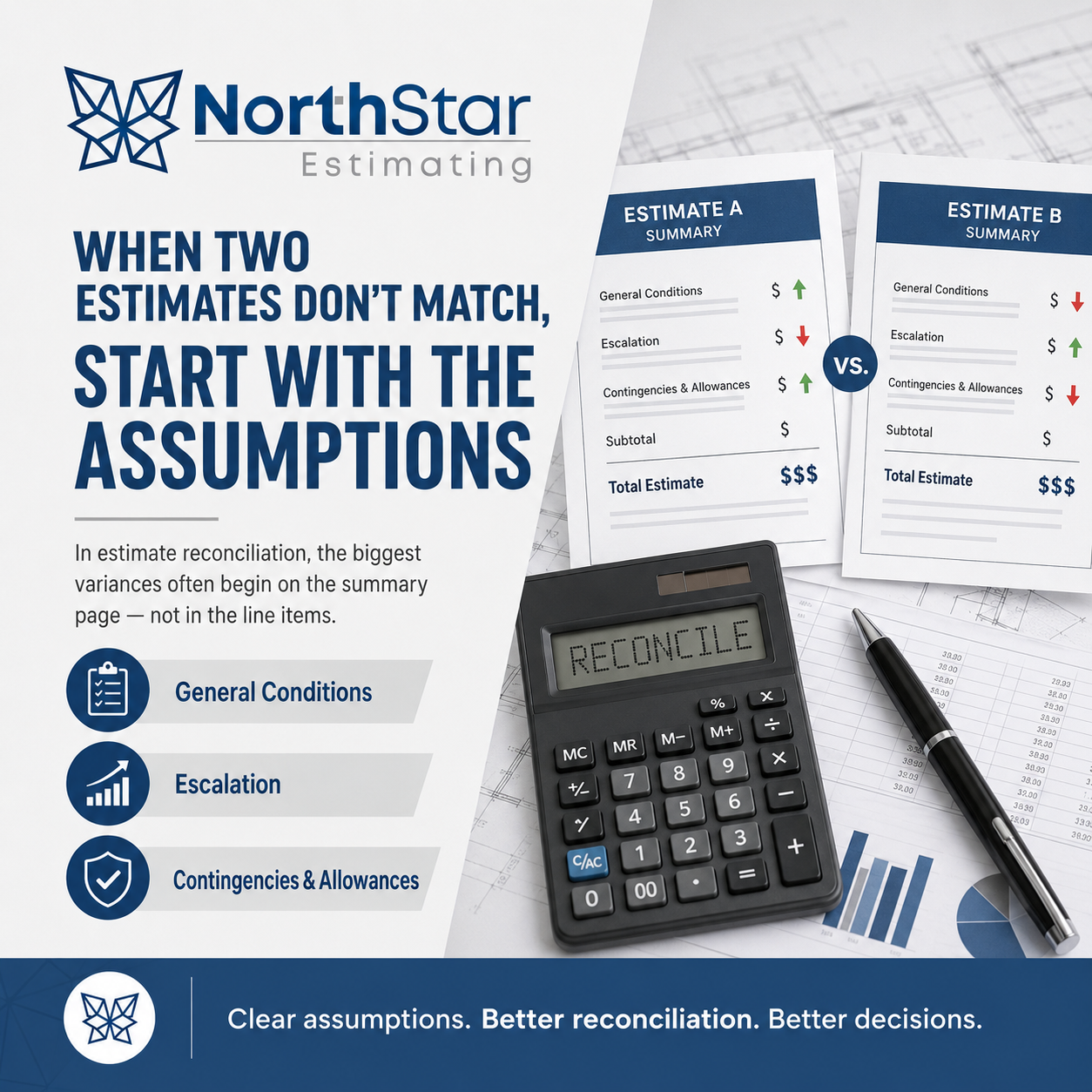
In preconstruction, it is common for two estimates to come in with very different totals.
The first reaction is usually to jump straight into the trade detail: concrete, drywall, HVAC, electrical, sitework, and everything in between. That work matters, of course. But in many reconciliations, the biggest differences are not always buried in the unit prices.
They are sitting on the summary page.
General conditions. Escalation. Design contingency. Contractor contingency. Bonds. Insurance. Fee. Owner-held risk. Allowances. What is inside the GMP and what is carried outside of it.
If those assumptions are not aligned, two estimates can look far apart even when both teams are generally seeing the scope the same way.
Reconciliation Is More Than Comparing Line Items
A good estimate reconciliation is not just a line-by-line exercise. It is a process of making sure everyone is pricing the same project, under the same assumptions, at the same point in time.
Before debating whether a unit price is high or low, the team should first confirm the estimate basis:
- Are we pricing the same scope?
- Are we using the same schedule duration?
- Is general conditions being carried as a percentage or as a fixed monthly cost?
- Is escalation being calculated to bid date, start of construction, or construction midpoint?
- Are contingencies inside the construction value, or are they being held separately by the owner?
- Are we carrying allowances once, or are we accidentally double-counting risk?
These are not minor formatting issues. They can materially affect the project total.
The Summary Page Can Hide the Biggest Variance
On public-sector projects, especially during SD, DD, and early CD phases, the estimate summary carries a lot of weight. It tells the owner not only what the project may cost, but also how much risk is being carried and where that risk is assigned.
A 10% design contingency and a 10% contractor contingency may both be appropriate in certain contexts. But if the owner is also carrying a separate contingency elsewhere, the team needs to understand whether those dollars are additive or duplicative.
The same applies to allowances and unforeseen conditions. If an estimate includes a district contingency, an E&O contingency, an unforeseen allowance, and a contractor contingency, the total may be technically explainable, but it may not represent the clearest basis for decision-making.
That can create unnecessary sticker shock.
The goal should not be to remove risk from the estimate. The goal is to make sure risk is being carried intentionally, transparently, and only once.
Align the Commercial Assumptions First
One of the most effective ways to improve reconciliation is to separate the conversation into two parts:
First, align the commercial assumptions. Second, reconcile the trade costs.
The commercial assumptions include items such as:
- General conditions and project duration
- Escalation rate and escalation period
- Contractor fee
- Bonds and insurance
- Design contingency
- Contractor contingency
- Owner-held contingency
- Allowances and exclusions
- GMP versus non-GMP cost structure
Once those items are aligned, the trade reconciliation becomes much more productive. The team can then focus on real scope differences instead of trying to reconcile estimates that are built on different frameworks.
Apples-to-Apples Matters
An estimate can be accurate on its own terms and still be difficult to compare.
For example, one estimate may carry general conditions as a percentage of direct cost, while another carries a fixed monthly cost based on an agreed schedule. One may include a contractor contingency inside the GMP, while another assumes the owner will hold that contingency outside the construction contract. One may escalate to bid date, while another escalates to midpoint of construction.
None of those approaches are automatically wrong. But they need to be understood.
If the owner, architect, contractor, and estimator are not looking at the same cost structure, the reconciliation can create more confusion than clarity.
That is why a clear Basis of Estimate is so important. It should explain not only what is included in the estimate, but also how the estimate is structured.
The Value of Independent Cost Estimating
An independent estimator can help the team identify where the real differences are.
Sometimes the issue is a missed scope item. Sometimes it is a different interpretation of the drawings. Sometimes it is a market condition. And sometimes, the trade costs are relatively close, but the estimate totals are far apart because the assumptions below the line are not aligned.
That is where reconciliation becomes especially valuable. It gives the team a chance to slow down, ask better questions, and make sure the budget reflects the project as intended.
Better Reconciliation Leads to Better Decisions
Owners and design teams do not need estimates that simply produce a number. They need estimates that help them make decisions.
A good reconciliation process should result in a clearer understanding of:
- What the project currently includes
- What is still developing
- What risks are being carried
- Who is carrying those risks
- What assumptions are driving the total
- What needs to be resolved before the next estimate
When those items are clear, the estimate becomes more than a budget document. It becomes a decision-making tool.
Final Thought
When two estimates do not match, do not start by assuming one is right and the other is wrong.
Start with the assumptions.
Once the basis is aligned, the real reconciliation can begin.