


Designing with Cost Awareness: Protecting Design Excellence While Meeting the Budget
By NorthStar EstimatingJune 18, 2026
In design and construction, cost conversations can sometimes feel like a constraint on creativity.
They do not have to be.
When handled early and thoughtfully, cost awareness can actually protect design excellence. It helps the team understand where the money is going, where the project has flexibility, and where smart decisions can preserve the intent of the design while staying aligned with the fiscal expectations established in the RFP.
That distinction matters.
Designing with cost awareness does not mean reducing quality. It does not mean stripping away the architectural idea. It means being intentional. It means understanding which decisions carry the greatest cost impact and which design moves create the most value for the owner, the users, and the long-term performance of the building.
The Budget Is Part of the Design Problem
Every RFP comes with a set of expectations. Some are programmatic. Some are technical. Some are schedule-driven. And almost always, some are financial.
The project budget is not separate from the design challenge. It is part of it.
When the budget is treated as something to check only at milestone submissions, the team loses the opportunity to make informed decisions while the design is still flexible. By the time an estimate shows a significant overage, many major decisions may already be embedded in the drawings.
At that point, the conversation often becomes reactive.
What can be reduced? What can be deferred? What can be simplified?
Those may be necessary conversations, but they are not always the best conversations.
A better approach is to bring cost awareness into the design process early enough that the team can shape the project with a clearer understanding of cost, risk, and trade-offs.
Cost Awareness Should Support the Design
Good cost estimating should not be about saying no.
It should help the design team understand where the project is carrying cost and why.
Sometimes the highest-cost item is also one of the highest-value parts of the project. In those cases, the estimate helps justify and protect that decision. Other times, the estimate may reveal that a particular system, material, or detail is consuming more of the budget than expected without meaningfully improving the project outcome.
That is where the conversation becomes useful.
The goal is not to make every element cheaper. The goal is to identify where cost and value are aligned, and where they are not.
That requires collaboration with each discipline. Architecture, structural, civil, landscape, interiors, mechanical, electrical, plumbing, and low-voltage systems all influence the final cost. Often, the best opportunities are not found in one large reduction, but in a series of coordinated decisions across the team.
High-Impact Areas Deserve Early Attention
Not every design decision has the same cost impact.
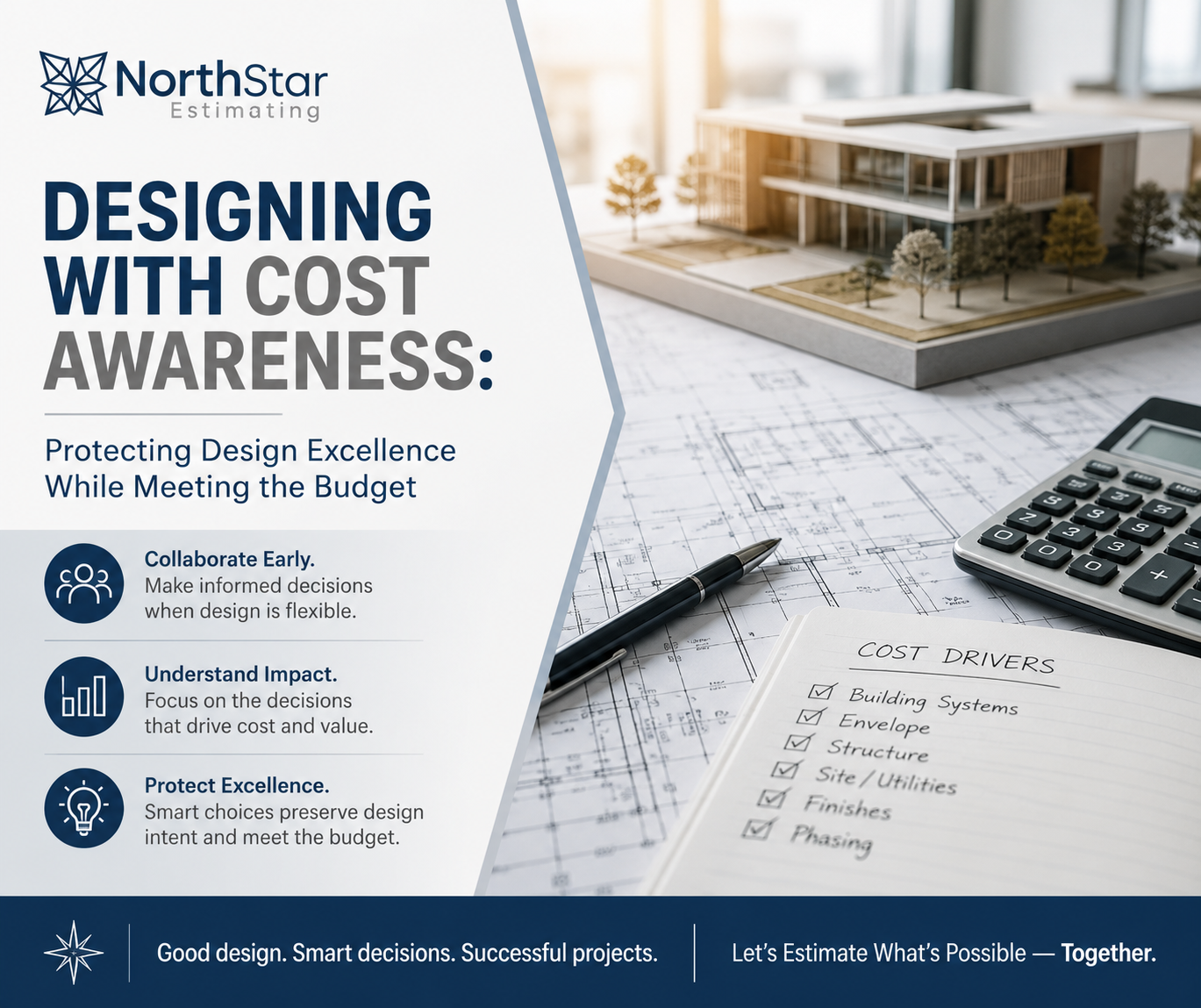
Some areas deserve early focus because they can significantly affect the budget, schedule, or constructability of the project. These may include:
- Building area and program efficiency
- Structural systems and spans
- Exterior envelope and glazing
- Sitework, grading, and utilities
- HVAC system selection
- Electrical service and infrastructure
- Phasing and temporary facilities
- Finish levels in high-volume areas
- Existing-condition risk in renovation work
These are not just estimating categories. They are design decisions.
When these areas are reviewed early, the team can make informed choices before the project becomes too rigid. That is especially important on public-sector work, where the RFP budget may be tied to funding approvals, board expectations, bond programs, or agency commitments.
Once those expectations are set, the design team has to deliver within a financial framework that may not have much flexibility.
Early Cost Input Creates Better Options
The earlier cost input is provided, the more useful it becomes.
At the beginning of a project, the team still has options. Systems can be compared. Details can be studied. Scope can be prioritized. Alternates can be structured. Phasing strategies can be tested. The budget can be used as a decision-making tool rather than a report card.
That is where independent cost estimating can add real value.
Instead of waiting until a milestone estimate identifies a problem, the estimator can work with the team to flag potential pressure points as the design develops. That allows each discipline to explore solutions while there is still time to make thoughtful adjustments.
For example, if the estimate shows early pressure in the mechanical scope, the answer may not be to simply reduce the system. The better conversation may be about equipment selection, distribution, controls, roof impacts, electrical capacity, ceiling coordination, access requirements, or phasing.
The same applies to architectural scope. If finishes are trending high, the answer may not be to reduce quality across the board. It may be to focus premium materials where they matter most and use more efficient solutions in secondary areas.
Cost awareness helps the team be strategic.
The Best Solutions Are Usually Collaborative
Cost-effective design is rarely the result of one discipline working in isolation.
A more efficient mechanical solution may require architectural coordination. A site utility decision may affect civil, electrical, plumbing, and landscape scope. A structural change may influence ceiling heights, exterior detailing, and MEP routing.
That is why cost discussions should not be treated as a separate estimating exercise. They should be part of the project dialogue.
When the estimator understands the design intent, the estimate becomes more meaningful. When the design team understands the cost drivers, the design becomes more informed.
The strongest outcomes usually happen when the team can sit together and ask:
- Where is the project carrying the most cost?
- Which costs are essential to the design intent?
- Which costs are being driven by uncertainty?
- Where can we simplify without compromising the outcome?
- Where should the owner invest because it creates long-term value?
Those are the conversations that help protect both the design and the budget.
Cost Awareness Protects Design Excellence
There is a difference between designing down and designing wisely.
Designing down usually happens late, under pressure, when the project is already over budget and the team is forced to make reductions quickly.
Designing with cost awareness happens earlier. It gives the team better information, better options, and more control over the final outcome.
At NorthStar Estimating, we believe cost estimating should support the design process, not interrupt it. Our role is to help teams understand the financial impact of their decisions, identify high-impact areas early, and work with each discipline to find solutions that are both thoughtful and realistic.
Design excellence and fiscal responsibility do not have to compete with each other.
When cost awareness is part of the process from the beginning, they can support the same goal: a project that is well-designed, well-planned, and aligned with the expectations set from day one.
NorthStar Estimating, Inc. provides independent cost estimating and cost management services for public-sector, institutional, and complex building projects. We help design teams understand cost drivers early, protect design intent, and make confident budget decisions from concept through construction.